Swiss Net Salary & Tax Calculator
High-precision deduction engine calculating your net monthly and annual take-home salary after AVS/AI (5.3%), AC (1.1%), LPP 2nd pillar pension, and cantonal withholding tax (Quellensteuer).
Determines Pillar 2 LPP savings bracket
Child deductions (Art. 38 DBG)
Take-Home vs. Deductions Allocation
Visual breakdown of each Swiss Franc earned
CHF 120'000+ Threshold: Mandatory Ordinary Tax Assessment (NOV)
Your employer's Quellensteuer deduction is no longer your final tax burden. Here is what is legally required and the 4 deductions you can claim.
Mandatory Annual Ordinary Tax Assessment
Because your gross salary reaches or exceeds CHF 120'000/year (or worldwide net wealth exceeds cantonal wealth thresholds, e.g. CHF 80'000 in Zurich), your withholding tax is treated as an advance installment. You are legally required to file an annual ordinary tax return (Steuererklärung / NOV) with the Zürich tax administration.
The 2021 Reform Irrevocable Lock-In Rule
Under the revised Swiss Withholding Tax Ordinance (QStV), once you trigger or enter Ordinary Tax Assessment (NOV), you are permanently locked into filing regular tax declarations every year until you permanently leave Switzerland or obtain a permanent C permit. You cannot revert to Quellensteuer in future years.
4 High-Value Tax Deductions You Can Now Claim Under NOV:
Deduct up to CHF 7'258 (2026 maximum) directly from taxable income, saving approximately CHF 1'500–2'800 in cantonal taxes.
Deduct actual public transit expenses (GA / Halbtax / train pass) or the statutory bicycle commuting deduction (CHF 700/year).
Deduct up to CHF 3'200/year (CHF 15/day) for work-related meals if your employer does not provide a subsidized canteen.
Deduct certified Kita daycare fees (up to CHF 25'500 federal cap) and job-related vocational training expenses.
Statutory Deductions Breakdown
All percentages and deductions are grounded in Swiss Federal Law (AHVG, AVIG, UVG, BVG, DBG)
| Statutory Deduction | Rate | Monthly | Annual | Legal Article |
|---|---|---|---|---|
| AVS / AI / APG (Pillar 1)Federal 1st pillar retirement, disability & loss-of-income insurance. | 5.30% | CHF 530.00 | CHF 6'360.00 | Art. 14 AHVG |
| AC UnemploymentApplied up to the federal salary ceiling of CHF 148'200. | 1.10% | CHF 110.00 | CHF 1'320.00 | Art. 3 AVIG |
| AANP AccidentCovers accidents outside work hours, for employees working 8+ hrs/week. | 1.00% | CHF 100.00 | CHF 1'200.00 | Art. 91 UVG |
| LPP Pension (Pillar 2)Pillar 2 retirement savings on coordinated salary. (Age 35–44 (10.0% total / 5.0% employee)) | 5.00% | CHF 267.75 | CHF 3'213.00 | Art. 7, 8, 16 BVG |
| Total Social Deductions | 10.08% | CHF 1'007.75 | CHF 12'093.00 | SR 831 - 837 |
| Net Salary Before Withholding Tax | — | CHF 8'992.25 | CHF 107'907.00 | — |
| Cantonal Withholding TaxPer Canton ZH, Tariff A withholding schedule for 2026. | 10.59% | CHF 1'059.00 | CHF 12'708.00 | Art. 83–86 DBG |
| Final Net Take-Home Pay | 79.3% | CHF 7'933.25 | CHF 95'199.00 | Take-Home |
Pillar 2 (LPP / BVG) Pension Savings by Age
Swiss Federal Law mandates progressive retirement savings contributions on coordinated salary. Contributions are split equally (minimum 50/50) between employer and employee.
| Age Bracket | Employee Share | Employer Match | Total Annual Savings | Legal Statute |
|---|---|---|---|---|
Under 25 Death & Disability risk coverage only (No retirement capital savings) | 0.0% | 0.0% | 0.0% | Art. 2 Abs. 1 BVG |
Age 25–34 Initial retirement capital accumulation phase | 3.5% | 3.5% | 7.0% | Art. 16 BVG |
Age 35–44Active (35y) Standard mid-career pension accumulation | 5.0% | 5.0% | 10.0% | Art. 16 BVG |
Age 45–54 Accelerated retirement wealth building phase | 7.5% | 7.5% | 15.0% | Art. 16 BVG |
Age 55–65 Final pre-retirement peak accumulation bracket | 9.0% | 9.0% | 18.0% | Art. 16 BVG |
How Coordinated Salary (Koordinierter Lohn) is Calculated
Under Art. 8 BVG, pension contributions are not deducted from your full gross salary. Instead, they apply strictly to your Coordinated Salary (Gross Salary minus the Coordination Deduction):
12 vs. 13 Months Salary (13. Monatslohn) Explained
In Switzerland, employment contracts specify either 12 equal monthly disbursements or 13 installments. Here is how both models compare for monthly cashflow, taxes, and take-home pay.
Tax & Social Deduction Neutrality (Art. 83 DBG):
Whether you receive 12 or 13 payouts, your total annual gross salary, withholding tax (Quellensteuer), and mandatory social deductions (AVS, AC, LPP) remain 100% identical. The only difference is monthly cashflow distribution vs. a double payment in December.
Art. 3 AVIG Unemployment Insurance Ceiling (CHF 148'200):
Unemployment insurance (AC / ALV at 1.10%) applies strictly up to the federal salary ceiling of CHF 148'200 (CHF 12'350 / mo), capping maximum employee contributions at CHF 1'630.20 per year. Earnings above CHF 148'200 incur 0.0% AC deduction (the solidarity surcharge was permanently repealed).
Is Your Swiss Salary Enough? 2026 Benchmark Analysis
Direct gross-to-net take-home pay, 33% rental affordability ceiling, and estimated monthly savings potential across Switzerland's most popular expat salary brackets.
CHF 120'000
/ yearSwitzerland & Zurich Expat Baseline
Mid-to-Senior Professional
Lifestyle & Purchasing Power:
Upper-middle-class living in Zurich. Covers a central 2.5-room flat, mandatory health insurance (KVG + VVG), leisure dining, and maximum Pillar 3a retirement contributions.
CHF 150'000
/ yearZurich Tech, Pharma & Finance Standard
Senior Specialist / Team Lead
Lifestyle & Purchasing Power:
Executive living on Lake Zurich. Covers a prime 3.5 to 4.5-room flat, family daycare support, alpine travel, and high monthly wealth accumulation in Pillar 3a and ETF funds.
CHF 100'000
/ yearGeneva, Vaud & Basel Standard
Solid Professional Standard
Lifestyle & Purchasing Power:
Comfortable living in Geneva or Vaud, above the national median (~CHF 81k). Covers a modern 2-room flat, private health insurance (LAMal), ski trips, and steady monthly savings.
Calculations based on 2026 Swiss Federal Tax & Cantonal Withholding tables (Tariff A0N, single, age 35, 100% workload). The 33% rent ceiling follows standard Swiss property management financial vetting guidelines.
| Statutory Deduction | Description | Rate | Monthly | Annual | Legal Article |
|---|---|---|---|---|---|
| AVS / AI / APG Pillar 1 | Federal 1st pillar retirement, disability & loss-of-income insurance. | 5.30% | CHF 530.00 | CHF 6'360.00 | Art. 14 AHVG / SR 831.10 |
| AC Unemployment | Applied up to the federal salary ceiling of CHF 148'200. | 1.10% | CHF 110.00 | CHF 1'320.00 | Art. 3 AVIG / SR 837.0 |
| AANP Accident | Covers accidents outside work hours, for employees working 8+ hrs/week. | 1.00% | CHF 100.00 | CHF 1'200.00 | Art. 91 UVG / SR 832.20 |
| Pillar 2 Pension Pillar 2 | Pillar 2 retirement savings on coordinated salary. | 5.00% | CHF 267.75 | CHF 3'213.00 | Art. 7, 8, 16 BVG / SR 831.40 |
| Total Social Deductions (Pillars 1 & 2 + AC + UVG) | 10.08% | CHF 1'007.75 | CHF 12'093.00 | SR 831 - 837 | |
| Net Salary Before Withholding Tax | — | CHF 8'992.25 | CHF 107'907.00 | — | |
| Cantonal Withholding Tax Quellensteuer | Per Canton ZH, Tariff A withholding schedule for 2026. | 10.59% | CHF 1'059.00 | CHF 12'708.00 | Art. 83–86 DBG |
| Final Net Take-Home Pay | 79.3% | CHF 7'933.25 | CHF 95'199.00 | ||
| Contribution | Legal Article | Rate | Monthly | Annual |
|---|---|---|---|---|
| Employer AVS / AI / APG Match | Art. 14 AHVG · SR 831.10 | 5.30% | CHF 530.00 | CHF 6'360.00 |
| Employer Unemployment Insurance Match | Art. 3 AVIG · SR 837.0 | 1.10% | CHF 110.00 | CHF 1'320.00 |
| Employer Pillar 2 Pension Match | Art. 7, 8, 16 BVG · SR 831.40 | 5.00% | CHF 267.75 | CHF 3'213.00 |
| Occupational Accident Insurance (AAP / BU) | Art. 92 UVG · SR 832.20 | 0.17% | CHF 17.00 | CHF 204.00 |
| Total Employer Surcharges | — | +9.25% | CHF 924.75 | CHF 11'097.00 |
How is Swiss Net Salary Calculated in 2026?
Understanding mandatory statutory payroll deductions across Swiss Pillar 1 (AHV/IV/EO), Unemployment (ALV), Pillar 2 (BVG/LPP), and Cantonal Withholding Tax (Quellensteuer).
In Switzerland, net salary is calculated by subtracting mandatory statutory social security deductions (AHV/IV/EO at 5.30%, ALV at 1.10%, and non-occupational accident insurance AANP ~1.20%), age-bracketed Pillar 2 BVG retirement contributions (3.50% to 9.00%), and cantonal withholding tax (Quellensteuer Tariffs A–H) from gross salary.
Net Salary = Gross - AHV/IV/EO (5.30%) - ALV (1.10%) - AANP (~1.20%) - BVG (3.5%-9%) - Quellensteuer2026 Mandatory Swiss Payroll Deductions Table
Federal statutory deduction rates, legal thresholds, and mandatory employee contributions under Swiss federal legislation.
| Deduction Category | Federal Statute | Statutory Rate | 2026 Salary Ceiling | Applies To |
|---|---|---|---|---|
| Pillar 1: AHV / IV / EOOld-Age, Survivors & Disability Insurance | Art. 3, 14 AHVG (SR 831.10) | 5.30%5.30% employer match | No Ceiling (Uncapped) | Total Gross Salary |
| Unemployment: ALV / ACMandatory Unemployment Insurance | Art. 3 AVIG (SR 837.0) | 1.10%1.10% employer match | CHF 148'200 / yr (CHF 12'350/mo) | Gross up to CHF 148'200 (0% above cap) |
| Accident: AANP / NBUNon-Occupational Accident Coverage | Art. 6–10 UVG (SR 832.20) | ~1.20% - 1.50%Paid 100% by employee | CHF 148'200 / yr | Employees working > 8 hrs/week |
| Pillar 2: LPP / BVGOccupational Pension Savings | Art. 8, 16 BVG (SR 831.40) | 3.50% – 9.00%Min. 50% employer match | Coordinated: CHF 25'725 to CHF 88'200 | Coordinated Salary (Age 25 to 65) |
| Withholding Tax: QuellensteuerCantonal & Federal Tax at Source | Art. 83–110 DBG (SR 642.11) | 4.00% – 22.00%+Based on Canton & Tariff | Tariffs A, B, C, H | Foreign residents on B, L, G permits |
Official Worked Benchmark (Zurich, CHF 120'000 Gross)
Full breakdown for an unmarried expat on Tariff A0N (Age 35, 100% workload) under ESTV 2026 tables:
Visual 2026 Swiss Gross-to-Net Salary Waterfall
A comprehensive visual infographic explaining Swiss social security deductions, Pillar 2 pension coordination, and cantonal withholding tax on a CHF 120'000 gross salary.
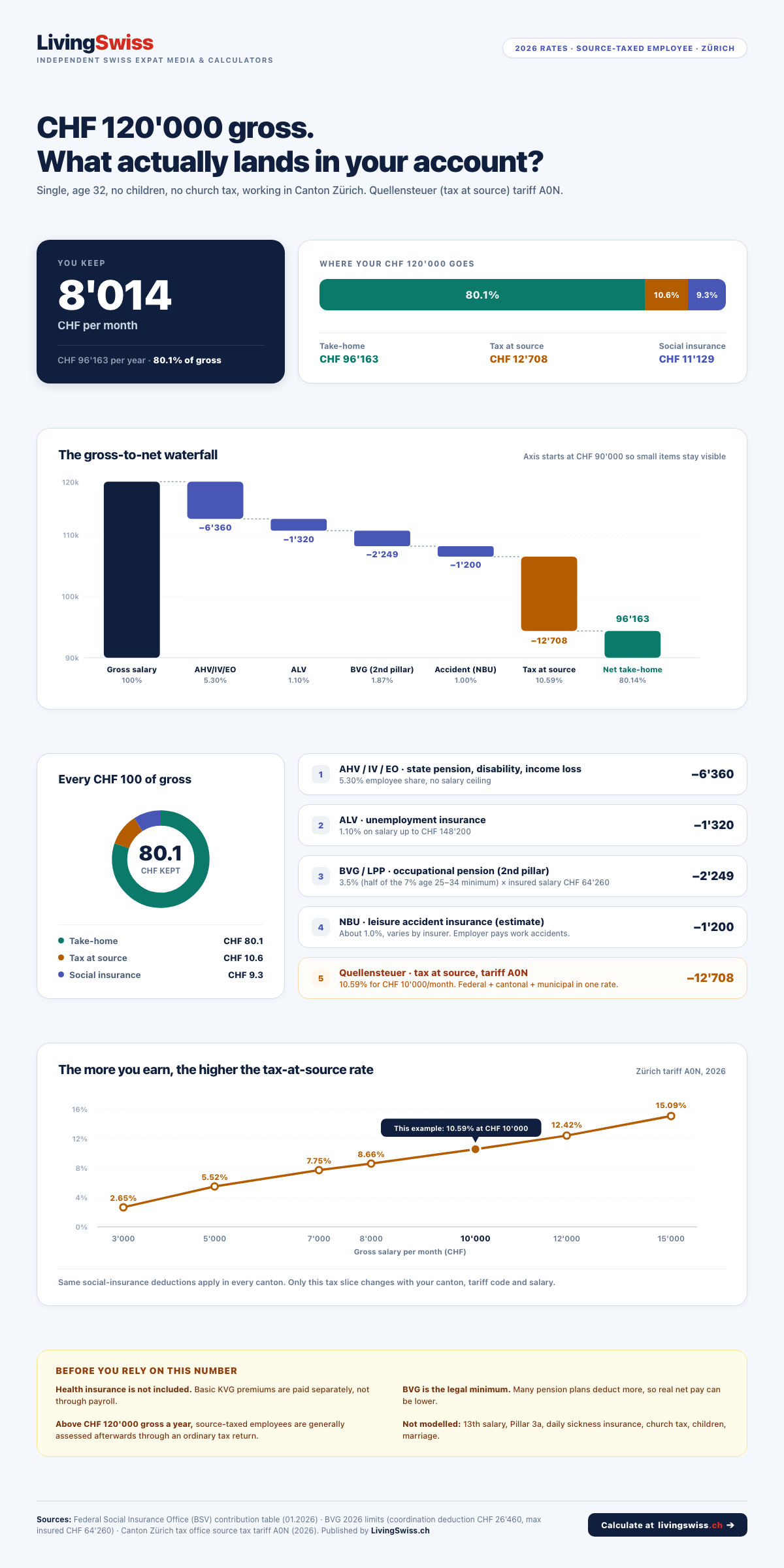
Embed this institutional infographic on your website or article. Free to republish with canonical link attribution to LivingSwiss.ch.
Swiss Salary Benchmarks & Withholding Tax FAQs
Direct statutory answers calibrated to 2026 Swiss Federal Tax Administration (ESTV) and cantonal social security regulations.
Is CHF 120,000 a good salary in Switzerland?
Yes. A gross annual salary of CHF 120,000 is considered very good for a single expat or couple in Switzerland, sitting well above the national median gross salary of approximately CHF 81,000. According to the Federal Statistical Office (BFS/FSO Household Budget Survey), the national average household disposable income is CHF 7,209 per month; an individual on CHF 120,000 in Zurich nets approximately CHF 8,014 per month (CHF 96,163/year) under official 2026 Quellensteuer Tariff A0N and standard social deductions (AVS, AC, LPP, NBU), exceeding the national average household take-home on a single income. Supported by steady Swiss economic fundamentals (SECO Q3 2026 GDP flash +0.2%), it provides a comfortable upper-middle-class lifestyle, enables renting up to CHF 3,300/month under the Swiss 33% gross rent rule, and allows CHF 2,500 to CHF 3,800 in monthly discretionary savings.
Is CHF 150,000 a good salary in Zurich?
CHF 150,000 is an excellent upper-tier salary in Zurich, common for senior software engineers, pharma project managers, and finance professionals. After Zurich Quellensteuer (approx. 14.5%) and social security deductions, the net take-home pay is around CHF 9,241 per month (CHF 110,892/year). Under Swiss rental guidelines (max 1/3 gross income), it qualifies you for rentals up to CHF 4,125/month, comfortably covering 3.5 to 4.5-room apartments along Lake Zurich while supporting substantial monthly savings of CHF 4,000 to CHF 5,500.
What is considered an executive or high-earner salary in Switzerland (CHF 180,000 to CHF 250,000+)?
A gross annual salary of CHF 180,000 to CHF 250,000+ places an earner in the top 5% to 8% of Swiss income distribution, common for directors, corporate legal counsel, and specialized trading executives. According to the Federal Statistical Office (BFS/FSO Nov 19, 2026), international trading hubs centered in Geneva, Zug, and Lugano generated CHF 17.1 billion in gross value added (~2.2% of Swiss GDP), sustaining compensation benchmarks well above the national median (CHF 81,000). On a CHF 200,000 gross salary in Canton Zurich, an expat takes home approximately CHF 11,840 per month (CHF 142,080/year) after social deductions and Quellensteuer; in Canton Zug, the lower cantonal tax multiplier leaves approximately CHF 12,980 per month net (CHF 155,760/year), delivering over CHF 13,600 in annual net tax arbitrage savings.
Is CHF 100,000 a good salary in Geneva or Vaud?
CHF 100,000 is a solid, comfortable salary in Romandie (Geneva and Vaud), sitting comfortably above the cantonal median. For a single expat on Tariff A, it yields a net monthly take-home pay of approximately CHF 6,392 (CHF 76,700/year). It qualifies for apartments up to CHF 2,750/month and allows a single resident to save CHF 1,500 to CHF 2,400 monthly after rent, groceries, public transit, and mandatory health insurance (LAMal).
What are the Swiss Pillar 2 (BVG / LPP) deduction rates by age?
Under Art. 16 BVG, mandatory occupational pension savings rates scale progressively with age on coordinated salary: Under 25 (0% savings, risk only), Age 25–34 (7.0% total / 3.5% employee), Age 35–44 (10.0% total / 5.0% employee), Age 45–54 (15.0% total / 7.5% employee), and Age 55–65 (18.0% total / 9.0% employee). By law, employers must contribute at least 50% of the total contribution.
How does a 13th month salary (13. Monatslohn) work in Switzerland?
A 13th-month salary (13. Monatslohn, Art. 322d OR) divides an agreed annual gross salary into 13 equal installments rather than 12. Total annual gross, withholding tax, and net take-home pay remain 100% identical under Swiss law. The 13th installment is disbursed alongside regular December payroll, providing a dual payout at year-end.
What is the Swiss unemployment insurance (AC / ALV) salary ceiling?
Under Art. 3 AVIG, mandatory employee unemployment insurance (AC / ALV) is 1.10% applied strictly up to the federal salary ceiling of CHF 148'200 per year (CHF 12'350 per month). The maximum employee contribution is capped at CHF 1'630.20 per year, and any income earned above CHF 148'200 incurs 0% AC deduction.
What is the 33% rent rule for Swiss salaries?
In Switzerland, property management agencies (Régies / Verwaltungen) strictly require that your monthly gross rent (including heating and utility charges / Nebenkosten) does not exceed 33.3% (one-third) of your monthly gross household income. For example, on a CHF 120,000 gross annual salary (CHF 10,000/month gross), the maximum permissible rent is CHF 3,300 per month. By comparison, official Federal Statistical Office (BFS/FSO) household budget data reveals that the average Swiss household spends CHF 1,546 per month on housing and energy (~21.4% of disposable income), meaning expat city rentals in Zurich or Geneva operate at the upper boundary of the national curve.
How much is Quellensteuer on a CHF 120'000 salary in Zurich?
In 2026, an unmarried expat on a B permit earning CHF 120'000 gross per year in Canton Zurich pays approximately 11.7% to 13.8% in cantonal withholding tax (Quellensteuer Tariff A0N), amounting to ~CHF 14'060 to CHF 16'560 per year, leaving a net annual take-home pay of approximately CHF 92'133 after standard social deductions.
What mandatory social security deductions are taken from a Swiss salary?
Under Swiss federal law, standard employee deductions comprise: Old-Age & Survivors Insurance (AVS/AI/APG at 5.30%, AHVG SR 831.10), Unemployment Insurance (AC at 1.10% up to the CHF 148'200 ceiling, AVIG SR 837.0), Non-Occupational Accident Insurance (AANP at ~1.20%, UVG SR 832.20), and Pillar 2 Occupational Pension (LPP/BVG from 3.5% to 9.0% depending on age, BVG SR 831.40).
When must an expat file an ordinary tax declaration (NOV) in Switzerland?
Under Art. 83 DBG, B-permit holders subject to withholding tax whose worldwide gross annual income exceeds CHF 120'000 (or who hold taxable worldwide wealth) must submit a retrospective ordinary tax declaration (Nachträgliche ordentliche Veranlagung - NOV) to their cantonal tax office by March 31 of the following tax year.
Can I deduct Pillar 3a contributions from Swiss withholding tax (Quellensteuer)?
Yes. Employed residents can contribute up to CHF 7'258 per year (2026 limit) to a recognized Pillar 3a pension plan and deduct 100% of these contributions from taxable income by submitting a formal NOV tax adjustment request before the statutory March 31 deadline.
When should an expat calculate net salary when relocating to Switzerland?
As early as the offer stage. According to the Federal Statistical Office (BFS/FSO Nov 20, 2026), over two-thirds (67%) of work-related immigrants arrive in Switzerland with a signed employment contract already in hand, while two-thirds of those arriving without a job secure employment within their first three months. Calculating your exact net take-home pay before signing is essential because Swiss gross wages are subject to mandatory Pillar 1 (5.30%), progressive Pillar 2 pension coordination, and cantonal withholding tax (Quellensteuer), which directly determines your maximum allowable apartment rent under the strict Swiss 33% gross income rule.
Stay Ahead of Swiss Tax, Rental & Legal Changes
Every Thursday morning: 2026 tax deadlines, rental deposit law updates, canton-by-canton comparisons, and verified expat guides directly to your inbox.
- 2026 ESTV tax tariff changes & Pillar 3a deduction limits
- Art. 257e OR rental law rulings & apartment handover checklists
- Cantonal tax burden & LAMal health premium comparison alerts
- 100% English-first independent insights (0% fluff)